The cost of a Syrian business website isn’t your peak-hour problem. When pressure hits, orders arrive by phone, through WhatsApp, via your in-house app, and each channel plays by its own rules. Between three and five tiny signals tell you the system is leaking: a customer calls again for status, the kitchen asks for a missing ticket number, and the accountant hunts for a paper slip.
Many restaurant owners we see juggle multiple tools at once. The usual picture: one person writes in a notepad, another replies on WhatsApp, a third syncs with an old accounting program. Under load, duplication creeps in, orders go missing, and customers are blind to their order status.
The operational problem
The core issue isn’t just order volume, it’s multi-channel sprawl without a single order queue that spans intake to handoff. The average owner we work with runs operations on three to five separate tools: WhatsApp for quick requests, Excel for ad hoc tracking, an old accounting app for invoices, sometimes a POS, and a paper notebook for emergencies. Each tool works, but there’s no single brain.
When channels aren’t unified, duplication becomes normal. A phone order gets recorded, then the same customer texts because no confirmation arrived. Result: a duplicate ticket hits the kitchen, or a ticket vanishes because it never crossed from paper to system. We’ve seen the same pattern elsewhere: about seven out of ten owners we know lean on a mix of WhatsApp and Excel instead of a purpose-built flow.
Sprawl shows up at day-close, and worst at month-end. If you run on disconnected tools, closing the month can take five to ten working days. Every day without tight reconciliation widens the gap between real work and billed revenue. Without a clear trace for each order’s journey, fixing discrepancies costs more time.
There’s also a human angle: onboarding a new cashier into this mess is rough. When the interface is Arabic-first, with clear labels and confirmations, non-technical onboarding drops from shadowing for days to under four hours of hands-on. Today, on scattered tools, you pay that extra onboarding tax.
Why off-the-shelf tools fall short
Off-the-shelf POS or CRM for restaurants nail the standard cases: dine-in tickets or one-channel delivery. But once your channels span calls, WhatsApp, maybe Telegram or Facebook Messenger, they struggle. Every new exception breaks on some weird edge case right at peak time.
You feel it in week one under pressure: the kitchen queue ignores delivery priority, prints incomplete work orders, or never sends a confirmation. Most assume the in-app flow is the only source of truth, yet restaurants hop between at least three to five tools by shift.
- Limited integrations; APIs often miss real lifecycle events for orders.
- Hard to enforce a single queue; each channel creates its own ride.
- Weak Arabic-first UX; new staff get lost in unfamiliar terms.
- Costly customization; one routing tweak can feel like rebuilding from scratch.
- Reports track invoices, but not bottlenecks across channels.
Faced with these limits, you’re stuck choosing between forcing customers onto one channel and losing orders, or keeping tool sprawl and losing clarity and nerves during rush hour.
TRBD’s approach
We work on two complementary tracks: web platform development and mobile apps. The aim: one “Unified Order Gateway” that swallows phone calls, WhatsApp, walk-ins, and your in-house app, then feeds a single kitchen queue and a single back-office console.
Practical steps we follow:
Flow discovery: we map your peak hour step by step. From the first “hello” on a call, to the first WhatsApp ping, to the first in-store tap. We define order and customer states in Arabic-first language.
Queue design and build: we craft clear UIs from scratch via web platform development or native/hybrid mobile apps, then wire API integrations to your live channels. Every order, from any source, enters one numbered queue with visible state.
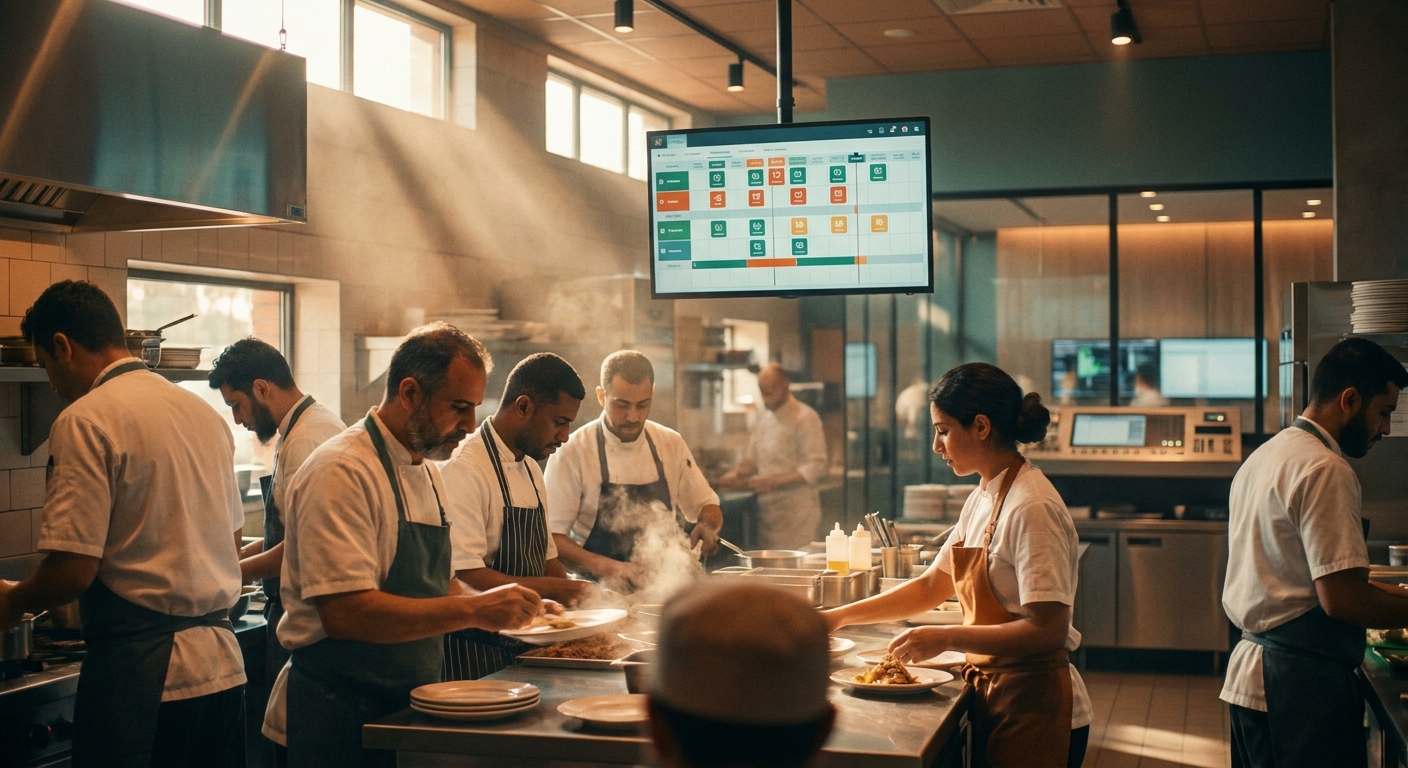
Kitchen screen and instant updates: your kitchen sees a prioritized list with practical buttons: “Send to kitchen” (Send to kitchen), “In prep” (In prep), “Out for delivery” (Out for delivery), “Delivered” (Delivered). In the back office, the console surfaces options like “Show notifications” (Show notifications) and “Update status” (Update status).
Pilot and go-live: the typical path to a first production version lands between a month and a month and a half from kickoff. If you need integrations across multiple departments or external platforms, expect two to three months. In month one, support usually sees fifteen to twenty-five tickets as users hit rare edge cases; after the first two months, this settles to two to four per month.
Growing the system: adding a second module on top of an existing TRBD system usually takes two to three weeks because the data model and auth are ready. This makes scaling calm and predictable.
Scope always includes: UX/UI design, full-stack development, API integrations, deployment and maintenance. What we need from you: your current channels and the roughest peak scenarios. We turn that into an executable backlog.
The practical outcome: the kitchen receives a single stream, customer service sees live states, and accounting finds full order journeys in one place. New-hire training becomes notably faster when labels are Arabic and precise, often dropping to under four hours of hands-on.
Before you ask about the cost of a Syrian business website
A popular question is “what will the platform cost?” It’s fair. But when your daily pain is missing orders, sequence matters. A first production version typically ships between a month and a month and a half. In that window, you get the core relief: a system that eliminates chaos, not just a gallery for your menu.
If you already have a site and later decide to add unified ordering, adding that module on top of an existing TRBD build usually takes two to three weeks. That’s a very different cadence than starting from scratch. Think hierarchy: first the unified queue, second a clear kitchen screen, third lifecycle-aware reporting. Then ask about your marketing layer, or the cost of a Syrian business website as the brand face that completes the system.
How to start with us
Email info@trbd.net with a short note about your current channels and peak-hour pain. Or talk to us on WhatsApp Turkey at https://wa.me/905537323153 or WhatsApp Syria at https://wa.me/963992367582. We’ll run a free initial assessment and co-draw your first order flow and plan.
Got the same problem? Drop a comment and tell us where orders get duplicated or lost.
Toward a new operating model for Damascus restaurants
Multi-channel ordering isn’t an exception anymore. Customers pick the channel they like, and smart restaurants make every path land in one queue. Across sectors we see the same pattern: owners run on three to five tools. If you embrace that fact instead of fighting it, and build a unified gateway on top, you shift cognitive load from people to the system.
From a finance lens, closing the month on a tool mix takes five to ten working days. After moving to a unified platform, many cases close in under forty-eight hours within the first quarter. You win twice: one day of real work instead of error-hunting, and one day of faster decisions because your reports are fresh.
On investment cadence, a month to a month and a half to first value is a rational trade for shedding daily chaos. If you want to deepen the platform later, two to three weeks for a second module is realistic when the model is in place. That unlocks a stair-step growth path: kitchen first, delivery second, promotions third, marketing site fourth.
My practical recommendation: before any fresh marketing spend or asking about the cost of a Syrian business website, sit with your team for one hour and map the order journey. Name the states in Arabic, and mark the core controls: “New order” (New order), “Cancel” (Cancel), “Complete” (Complete) on paper. Then converge every channel onto one queue via web platform development or mobile apps. Once that’s stable, any new channel becomes just another connector—not a brand-new process to invent.
The pattern is clear around us: teams with a unified order queue stroll through rush hour; teams split between paper, WhatsApp, and Excel bleed nerves and tickets. It’s your call today, and your team’s calm—and your customer’s confidence—tomorrow.