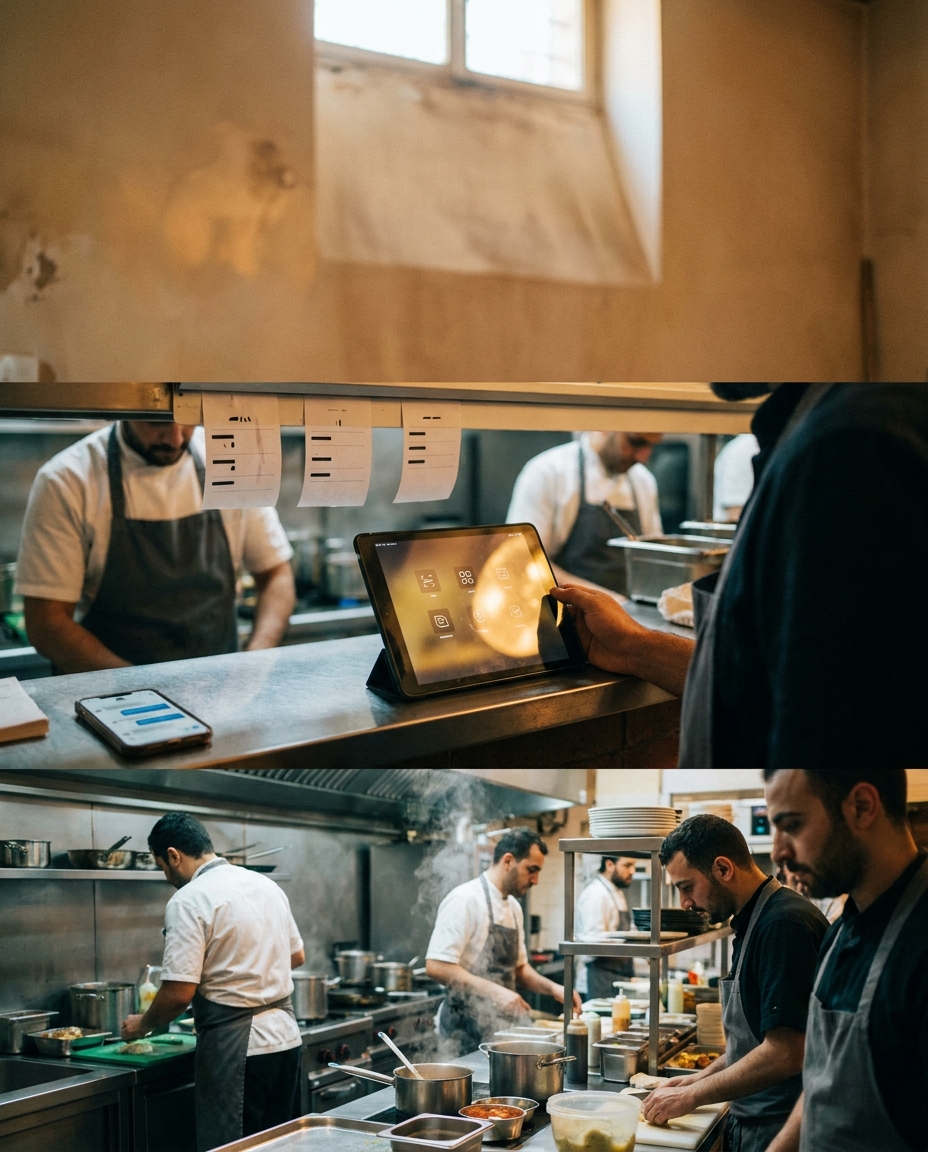
Yesterday at a busy street restaurant, four tables had their orders stuck because the cashier’s paper slip didn’t match the kitchen’s slip, and the message on WhatsApp never reached the chef. The employee problems during new system install Syria were obvious: everyone blamed someone else, and the customer waited an extra hour without knowing why.
The operational problem
Losing orders between paper and WhatsApp does more than delay a customer; it halts the entire production line. When the paper slip doesn’t match the order sent through the messaging app, the restaurant spends extra hours tracking down the error and assigning blame. In some cases, a single lost order forces the kitchen to rearrange and cancel dishes, meaning wasted chef and assistant time.
Restaurant owners live similar scenes: the service team writes orders in notebooks, while another staff member sends details to delivery services through the app. Any delay in logging or correcting mistakes disrupts the whole cycle. When errors repeat, there is a direct loss from future customer drop-offs and damaged reputation.
The problem grows when the restaurant operates across multiple sales channels — indoor dining, phone orders, delivery app orders. Each channel has its own log, and there is no unified system to link information in real time. This fragmentation increases staff load and lets orders slip between steps.
In cases we’ve observed, correcting errors without a central system takes long, sometimes requiring a complete restart of the food preparation cycle, delaying other customers.
Why off‑the‑shelf doesn’t cut it
POS systems or restaurant management apps from the market may fit very small restaurants but stop meeting requirements when channels multiply or custom integrations are needed.
- Most ready-made systems don’t integrate with all order and delivery platforms smoothly.
- They can’t customize workflows to match the restaurant’s structure.
- Error management across channels isn’t built-in, increasing recovery time.
- They lack instant reports showing operational causes of lost orders.
These limits make off‑the‑shelf tools insufficient for a restaurant losing orders between paper and messaging apps.
TRBD’s solution
Here, TRBD’s mobile app development and web platform development services can build a unified order management system. The app links the service team, kitchen, and delivery channels in an Arabic-first interface with English as needed.
Project steps:
- Discovery session to map current workflow in detail.
- Design clear UX/UI to suit the team’s language.
- Develop a Full‑stack system uniting all input points.
- Integrate with delivery order platforms via API.
- Test in live environment before launch.
Expected outputs:
- Unified screen showing all orders from all channels.
- Real-time kitchen updates for new orders.
- Instant delay reports with causes.
This closes the gap between paper, WhatsApp, and kitchen workflow.
How a client starts with us
A restaurant owner can email info@trbd.net or use WhatsApp Turkey https://wa.me/905537323153 or WhatsApp Syria https://wa.me/963992367582 to request a free initial workflow assessment.
Toward a new operational model for Damascus restaurants
From our experience, moving to a unified central system shortens error recovery time and raises service levels. Real client data shows that system stability reduces support tickets to between 2 and 4 per month after initial operation. Arabic‑first interfaces cut non‑technical new staff training time to under four hours.
In the Damascus restaurant sector, competition on service speed and quality is now a core success measure. Custom systems give full control of the order cycle and prevent data loss between channels. This trend is expected to grow with increasing app-based orders. Our recommendation is to start with an assessment session, without accepting current workflows if they cause time or reputation loss.
Looking at similar cases, a unified application not only fixes lost order issues but opens the door to improvements like linking inventory and billing systems, boosting overall profitability.