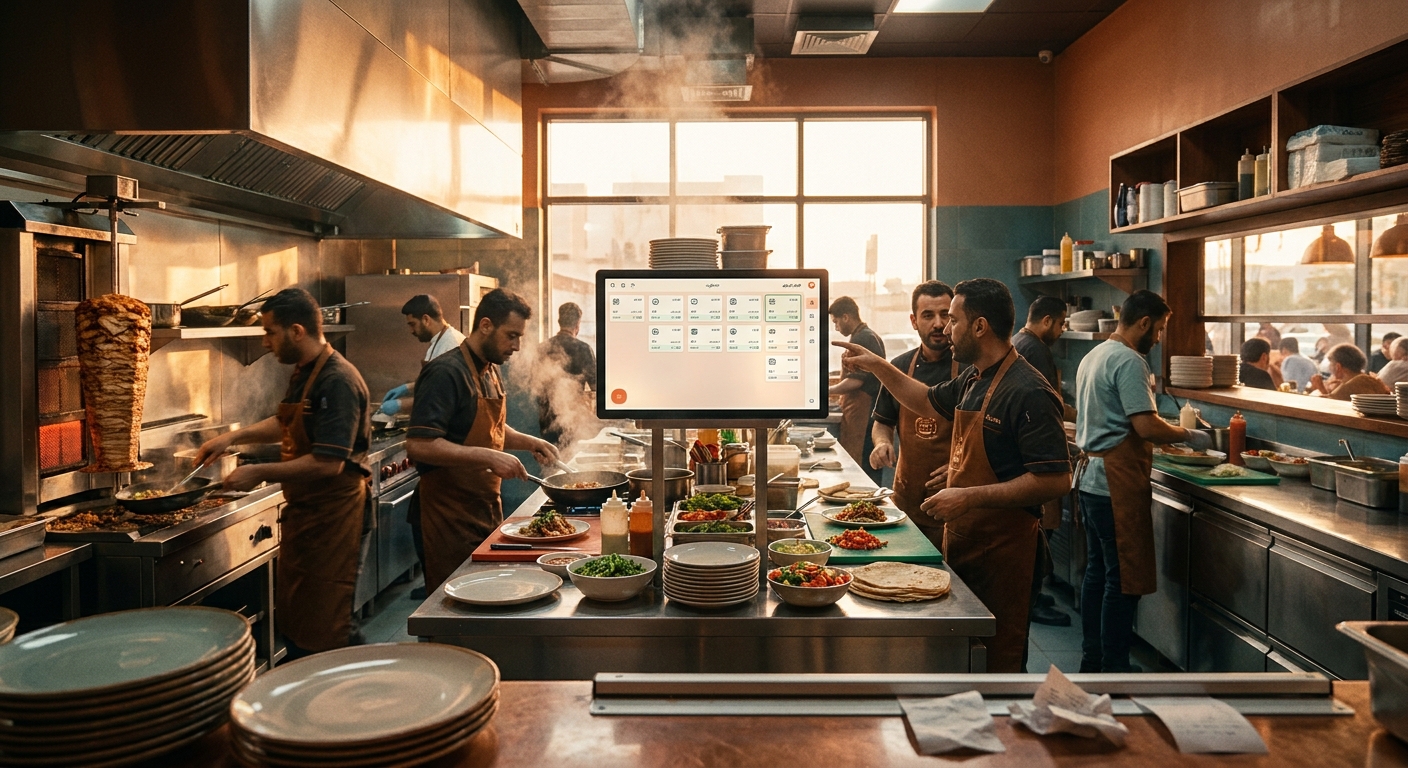
A custom CRM for Arab businesses won’t just boost sales; it unifies WhatsApp, phone, and delivery-app orders into one clear kitchen queue. The problem isn’t headcount, the problem is dish sequencing and the flow between dining room, kitchen, and cash. If the queue is wrong, everything is late — even with extra cooks.
Picture this: 7:30 pm rush, 12 tables seated, phones ringing, third‑party delivery orders spiking, and steady WhatsApp regulars. Five tickets land at once: a phone ticket with vague notes, a delivery‑platform order with long instructions, and a WhatsApp order split across three messages. Without a single kitchen queue, the chef cooks the closest paper on hand, and the queue collapses.
The operational problem
Kitchens don’t fail because they’re weak; they fail because priorities are unclear. When paper or the POS screen hands the kitchen only one channel’s truth, every other channel is invisible. The chef sees “the latest that arrived,” not “the next that must go.” Result: trays waiting on a missing component, a dine‑in guest delayed because their sandwich got bumped for an outbound delivery, and a driver fuming outside.
By the numbers: before we touch any account, operations typically sprawl across 3–5 tools — WhatsApp, Excel, a local accounting app, and a POS at the till. Operational comms usually run through 4–7 separate WhatsApp groups — suppliers, drivers, floor, kitchen, accounting. This alone manufactures kitchen priority chaos, because the kitchen is last to see a complete order.
A common pattern: the phone clerk writes an order on paper and walks it to the kitchen, while, in the same minute, a delivery‑platform order lands in the POS. Paper reaches the chef first, so he starts it, even if the platform order is older in real time. Fifteen minutes later, two plates sit ready but missing items from the older order, lost between channels.
Even if you have a “kitchen screen,” if there isn’t a single source of truth, the screen just replaces paper, not chaos. Items are named differently per channel (“Burger” on WhatsApp, “Classic Burger 150g” on the app, “Burger Sandwich” internally), so the kitchen treats them as distinct dishes. Without explicit prioritization rules (age, promised time, hot vs. cold, consolidation), decisions become on‑the‑fly — the worst kind of decision under peak pressure.
A small point with big impact: any manual handoff before the kitchen — paper, screenshot, call — loses timing or detail. When the daily flow relies on “enter it here and print it there,” you pay minutes per ticket, and peak minutes cost reputation directly.
Why off‑the‑shelf won’t cut it
Most POS packages are strong at the point, weak on the path. They log, print, and invoice, but they don’t orchestrate the multi‑channel journey into one kitchen flow. Generic CRMs think customer and sales, not tickets and cooks. Bolt them together in a three‑channel kitchen and you get a half‑solution: a screen that displays, not a system that decides.
Why? Because the Arab restaurant rush has channels many products don’t see: a regular on WhatsApp paying cash on delivery, a local delivery platform shifting prices or ETAs, and live phone adjustments. Off‑the‑shelf assumes a unified order format before it helps you — and that’s the snag.
- Fixed priority templates fall short: you need dynamic rules by promise time, cook load, and dish batching.
- Dish names and modifiers are local and fluid; you need a translation map across channels, not a forced “master menu.”
- If the delivery‑platform link only “pulls orders,” you’re left alone on sequencing.
- Arabic‑first UX isn’t a luxury — it cuts staff onboarding from days to hours.
We saw at a multi‑branch supermarket that daily stock reconciliation dropped from roughly two hours per day to under 20 minutes after we wired inventory to every sale. Same principle in kitchens: when intake, sequencing, and handoff are coupled automatically, the kitchen sets the tempo instead of chasing it.
The TRBD approach: custom CRM for Arab businesses in restaurants
We work on two tracks from our official services: ERP/CRM to be the “spine” for orders, customers, and tickets; and web platform development to aggregate channels via API integrations and ship an Arabic‑first Kitchen Display. We don’t sell you a “screen” — we shape the entire journey: intake, unify, prioritize, cook, handoff.
The practical steps:
Process discovery: a mapping session with the owner, head chef, and order clerk. We list actual channels, how dish names appear in each, and pinpoint bottlenecks.
Channel unification: a single intake gateway for WhatsApp via a mediator, delivery platforms via API, and phone via fast Arabic‑first entry. Every order is born with normalized properties: due time, channel, delivery location, initial priority.
Smart kitchen sequencing: a main Kitchen Display with priority rules — age, delivery before dine‑in when a driver window is about to expire, batching similar dishes inside a time window. Clear Arabic buttons like “ابدأ الطبخ الآن (Fire Now),” “انتظار (Hold),” and “جاهز للاستلام (Ready for pickup).” Every action logs directly on the ticket.
Expo screen for floor and drivers: a handoff screen showing driver runs and batches, with optional handoff print. A “نداء سائق (Call Driver)” button pings a ready driver via WhatsApp in simple language.
Operational reports: an Arabic report screen showing median prep time per dish, bottleneck windows, and each channel’s delay impact. No vague dashboards — a concise report screen you’ll use the next morning.
What’s in scope?
- Arabic‑first UX/UI down to validation and error copy.
- API integrations with local platforms or a simple mediator when a platform lacks an API.
- Deployment and care: web clients for kitchen and floor, with optional mobile for drivers.
By the numbers:
- First usable module typically ships in 3–6 weeks from discovery day.
- Adding a second module (like the driver run screen) takes 2–3 weeks because data and auth stand.
- Arabic‑first UX drops a non‑technical staffer’s onboarding to under 4 hours of guided use.
Before/after in short:
- Before: chef cooks whatever paper/screen he sees first. After: a single visible queue with explicit rules.
- Before: drivers wait on a missing item. After: automatic batching into clear driver runs.
- Before: end‑of‑month analysis is manual. After: daily concise operational reports you’ll act on.
How to start with us
Email info@trbd.net with a simple note on your peak‑hour pain, or ping us on WhatsApp Turkey at https://wa.me/905537323153 or WhatsApp Syria at https://wa.me/963992367582. We run a free 30‑minute first assessment to sketch your flow; if there’s a fit, we agree on a quick first module.
We won’t change your kitchen’s nature; we’ll let the kitchen lead the line instead of chasing it. 🛠
Toward a new operating model for Damascus kitchens
The next competitive edge in restaurants isn’t “more channels,” it’s a unified decision engine inside the kitchen. Peak winners will turn on real prioritization, not just a display. And here’s the point: the solution starts with understanding the process, not selling a system.
By the numbers across our clients, ops comms pre‑consolidation ran over 4–7 WhatsApp groups, and daily management lived across 3–5 tools. Consolidation doesn’t happen with a button; it happens with a dish‑name map, channel translation, then a Kitchen Display built on top. Arab restaurants run fast‑changing menus and dialects — another reason custom build actually matters.
Cross‑industry lens: law firms win when time is captured automatically, contractors win when bid costing gets unified. Restaurants win when the “cook order” becomes a living document — from the second it lands to the second it leaves for a driver or the floor. If you can move on‑the‑fly decisions out of the heat and into explicit rules, you’ll save two minutes on half your tickets — and those minutes are peak‑hour gold.
Our near‑term outlook: local platforms will keep opening integration doors, and every new door multiplies the value of a unified kitchen brain. But the real value won’t come from the integration itself; it will come from your rules: how you prioritize, what you batch, what you hold. That’s your edge. 📊
The problem isn’t channel count; it’s one correct line that leads the kitchen. How are you handling it today?