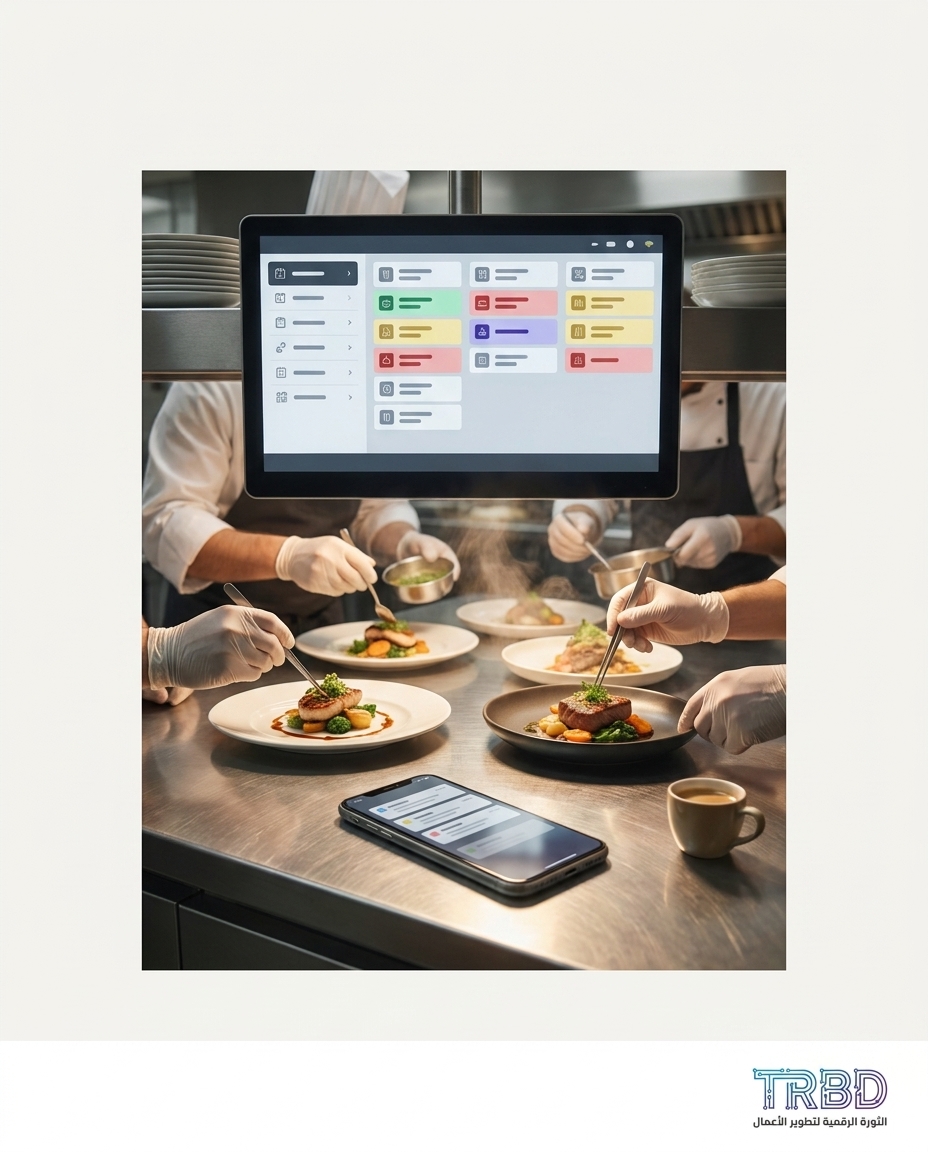
This morning, we applied a repair workshop work orders and parts app mindset to a Damascus delivery restaurant that started every day juggling a ringing phone, WhatsApp pings, and delivery app alerts. Complaints were leaving the back door faster than plates left the front because tickets were duplicated or forgotten between shifts. The owner said it bluntly: “I need something that stops the bleed, not another tool tour.”
The Situation
The restaurant is mid-sized, built on delivery and phone orders, receiving from four channels: landline, WhatsApp, an external delivery app, and walk-ins who leave tickets at the counter. The front-of-house team rotates, and when people change mid-shift they lose context about who spoke to which customer and what was promised. The problem wasn’t the kitchen, it was intake and delivery in the right sequence.
On our first observation day, we saw the owner running operations on 3–5 separate tools: WhatsApp, Excel sheets, an old accounting program, paper notebooks, and sometimes a POS terminal. That split creates gaps just big enough for a follow-up to vanish or a note about an allergy to go missing. Each channel runs alone, and no one sees the whole picture at crunch time.
Month-end showed the same pattern: collected papers and scattered Excels, with delayed “true-ups” while numbers are reconciled. In setups like this, closing the month tends to consume roughly 5 to 10 working days, and kitchens can’t afford that drag because daily cash needs real-time discipline. The final invoice isn’t just a number; it’s the memory of the process.
In our very first scoping session, we mapped the actual path of a ticket from entry to exit and compared it to what off‑the‑shelf systems truly cover. As we often see, the owner realized in under an hour that a custom system matched to his flow would be the right call. In our experience, about 6 out of 10 folks who come in looking to evaluate a prebuilt tool change their mind when they see the gap between their real flow and what the prebuilt allows.
The Action
We started with a single intake map that gathers every channel into one unified inbox. Any phone order is entered into the intake screen, any WhatsApp message is picked up by a lightweight automation, and any external delivery app order lands through a clean API integration. The point is: no ticket moves outside one numbered queue.
We built a custom web platform under our Web Platforms service, with an Arabic‑first console, and extended it with a light mobile app for riders under Mobile Apps. The UI follows clear steps: Received, Prep, Dispatch, and Close. One button sends the ticket to the kitchen, labeled in Arabic and English for clarity: “إرسال إلى المطبخ” (Send to kitchen), with another for special notes like allergies labeled “تحذير مكوّن” (Allergen note).
The core was stopping duplicates. We designed de‑duplication by triangulating three signals: phone number, item similarity, and time proximity to a recent ticket. When suspicion triggers, a confirmation modal appears: “Merge orders?” with quick links to cancel or merge. The decision no longer rests on a stressed memory, but on clear, simple rules.
We tightened internal comms so no one needs to “translate” between people. Conversation lives on the ticket card itself, and status buttons are explicit: “Ready for pickup,” “Out for delivery,” and “Closed.” Any change is logged with user and time, so a single source of truth tells who spoke to the customer and what was promised.
Under the hood, we modeled the work like a maintenance ticket that draws on parts. The dish is a header with line items, and add‑ons and discounts behave like parts you can track and charge. That’s the spirit of a repair workshop work orders and parts app, transposed to a fast kitchen, which makes the system resilient to new menu items and temporary offers with no confusion.
Accounting got proper treatment, too. Every ticket binds to an invoice tied to a customer or guest, rolling into day, week, and month closures. When intake lives in one place, month‑end behaves like one brain, instead of a chase across multiple paper trails.
On timing, we shipped the first working version in the typical window: between a month and a month and a half from kickoff. The stack was straightforward, integrations bounded, so we didn’t need two or three months. Post‑launch, we set tiered support and were clear that the first month would see 15 to 25 support tickets as users bump into rare edges, then it stabilizes at 2 to 4 per month.
One “small” detail on paper mattered in practice: Arabic‑first labeling. When staff see buttons like “إرسال إلى المطبخ” (Send to kitchen) instead of abstract jargon, they don’t need an in‑house translator. That cut onboarding for a non‑technical staffer from shadowing for days to under 4 hours of real, hands‑on training.
The Result
Three weeks into production, the daily rhythm changed. The phone no longer fights WhatsApp because both land in the same queue, and the external delivery app is now just another channel, not the conductor setting the tempo. The kitchen stayed the kitchen, but the stream feeding it turned into a fair line.
Practical impact shows up in operational markers any owner recognizes. We’re not chasing vanity numbers, just reality that proves simple steps unlock team capacity. The table below summarizes before/after using patterns we consistently see in similar clients:
| Approx. KPI | Before | After |
|---|---|---|
| Month-end close time | About 5 to 10 working days | Under 48 hours within the first quarter |
| Support tickets per month | First month: 15 to 25 | After stabilization: 2 to 4 |
| Onboarding time (non‑technical) | Days of shadow training | Under 4 hours of hands‑on |
| Adding a new module | A month and a half or more | Typically two to three weeks |
Since this alignment, “we sent the same order twice” stopped being a daily headline. When rare cases occur, they’re caught quickly because the single record flags a double as it happens. More importantly, customer conversations shifted from foggy excuses to professional follow‑through in one tone.
The owner’s takeaway: if tickets move on one rail, the kitchen will find its way.
The Arabic‑first console wasn’t a cosmetic choice. It became an operational asset that moved non‑technical staff to steady output fast, instead of sitting two days in the shadows. When buttons and reports call things by their names, confusion ends and questions turn into action.
Finally, the next add‑on conversation is calmer. When the owner asks for a promos or loyalty module, we know layering it on now usually takes two to three weeks because the data model and auth are ready, rather than a month and a half or more like the first project.
How we borrowed from a repair workshop work orders and parts app
The kitchen isn’t a car shop, but a ticket looks like a work order: symptoms and outcome. Add‑ons behave like parts that get logged and billed, and re‑opening after dispatch feels like reopening a maintenance ticket. When you design with that frame, states like “In prep,” “Waiting on an item,” and “Out for delivery” emerge naturally.
Putting that logic into a clear web platform made ticket state legible to anyone dropping into mid‑day chaos. No one needs to ask three people to learn who talked to the customer yesterday. The ticket card carries conversation history and time promises, and it prevents duplicates. That is the core of operations: one honest record.
A side effect the owner loved showed up in reports. Because everything walks through one door now, the analytics board tells the truth instead of guessing, and month‑end doesn’t feel like a cliff. What used to be 5 to 10 working days pressing on cashflow now typically closes in under 48 hours.
Lessons learned
Unify intake before chasing features. One inbox removes half the errors we see daily because it eliminates channel‑hopping.
Treat a dish like a work order with clear line items, and lean on the repair workshop work orders and parts app mindset. It makes add‑ons, edits, and returns trackable.
Go Arabic‑first for the console. Seeing labels like “إرسال إلى المطبخ” (Send to kitchen) and “طباعة تذكرة” (Print ticket) in the team’s thinking language drops onboarding time to under 4 hours.
Respect go‑live timing. A first version in a month to a month and a half builds trust, then add modules in two‑ to three‑week bites instead of a giant foggy plan.
Expect a spike in month one. Fifteen to twenty‑five support tickets isn’t failure; it’s discovery. Then it settles to two to four, which is healthy.
Have a similar case?
If this story feels close to yours, let’s walk your order flow together in a short, no‑pressure chat. Send the word “Restaurant” on WhatsApp via https://wa.me/905537323153 and we’ll propose a fitting time with concrete next steps.