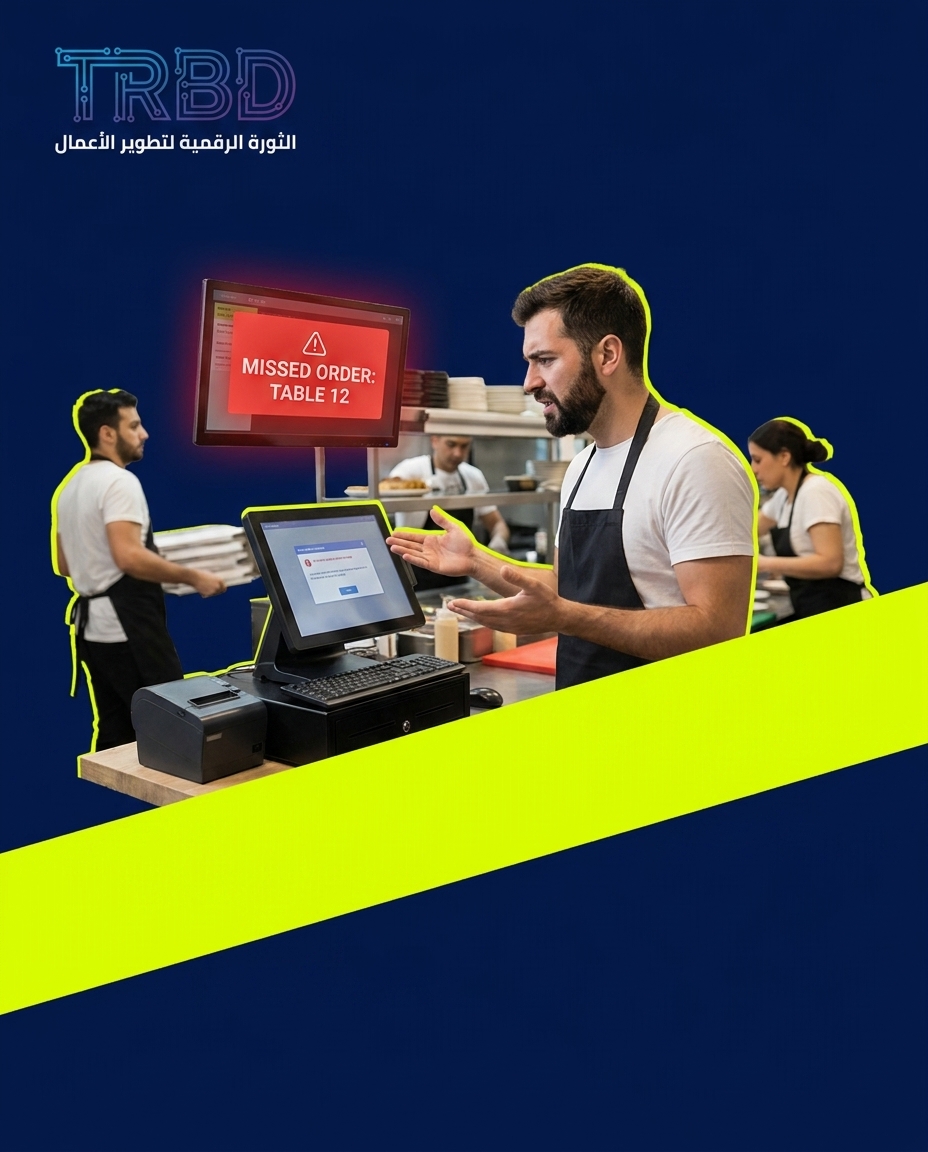
Yesterday, at a Damascus restaurant during lunch rush, customers were lined at the door. The cashier’s eyes were on the order screen and the paying customer, while the kitchen waited behind. Suddenly, a whole ticket for three dishes never reached the kitchen — the table doubled in wait time, and the order was billed without ever being cooked.
When such an incident happens, signs your current business system is failing in Syria become obvious, even if management claims 'the system is fine.' Lost orders during peak hours cost more than the price of a meal — they erode customer trust and waste staff time.
The operational problem
In restaurants, peak hours mean intense pressure on cashier and kitchen. If the cashier uses a paper notebook or slow manual entry to a system, error rates climb. In a mid-sized restaurant, one wrong entry can lose three dishes in one go and waste an hour of service.
About 7 out of 10 business owners we know process their billing via a mix of Excel and WhatsApp, not a dedicated system. This pattern in restaurants leaves order flow disconnected, creating mismatches between what the cashier logged and what the kitchen cooked.
Month-end close for a restaurant using Excel and paper invoices can take between 5 and 10 working days — time lost while order problems repeat.
The kitchen needs Immediate notification for each new ticket. If notification is delayed by even one minute during rush, the table is at risk of long waits or missing items.
In our Damascus case, the lost ticket was not due to bad intent, but because the system failed to link cashier and kitchen in one effective interface.
Why off-the-shelf doesn’t cut it
POS systems offer an entry screen and printouts, but aren’t always suited for a busy Damascus restaurant.
- No instant kitchen integration except via legacy printers that can stop suddenly.
- No live order status display for chefs.
- No verification log ensuring each ticket is cooked.
- No Arabic-first interface to speed training.
- Not customizable to handle peak seasons or split tickets across stations.
These limits force restaurants into inefficient workarounds, increasing lost ticket rates.
The TRBD fix
In this case, TRBD’s web platform development or mobile application service builds direct links between cashier and kitchen.
Project steps:
- Initial assessment session to understand ticket flow.
- UX/UI design for both cashier and kitchen.
- Full-stack development linking ticket entry to kitchen execution.
- API integration with billing.
- Deployment and monthly maintenance.
Scope includes:
- Ticket management dashboard.
- Instant kitchen notification.
- Verification log for every ticket.
- Multi-language support.
Expected outcomes:
- Drop in lost ticket incidents.
- Faster service times.
- Reduce monthly closing days from 10 to under 48 hours in the first quarter.
How a client starts with us
Any restaurant owner can contact us via email at info@trbd.net or WhatsApp Turkey https://wa.me/905537323153 or WhatsApp Syria https://wa.me/963992367582 to request a free preliminary evaluation identifying fault points.
Towards a new operational model for Damascus restaurants
The Damascus restaurant market is moving toward tighter integration between kitchen and cashier. As we saw, losing a single ticket during rush damages the restaurant’s overall image and pressures the team.
With an Arabic-first interface, training a new non-technical staff member drops from days of shadowing to under four hours of practical training. This means the restaurant is more resilient to staff changes.
We expect competition to rely more on speed and accuracy rather than menu decor. Custom systems that address failure points — like signs your current business system is failing in Syria — will be decisive for profitability.
The difference between a restaurant that logs every ticket on a unified screen and one relying on cashier’s memory is the difference between operations under control and operations at the mercy of circumstance.