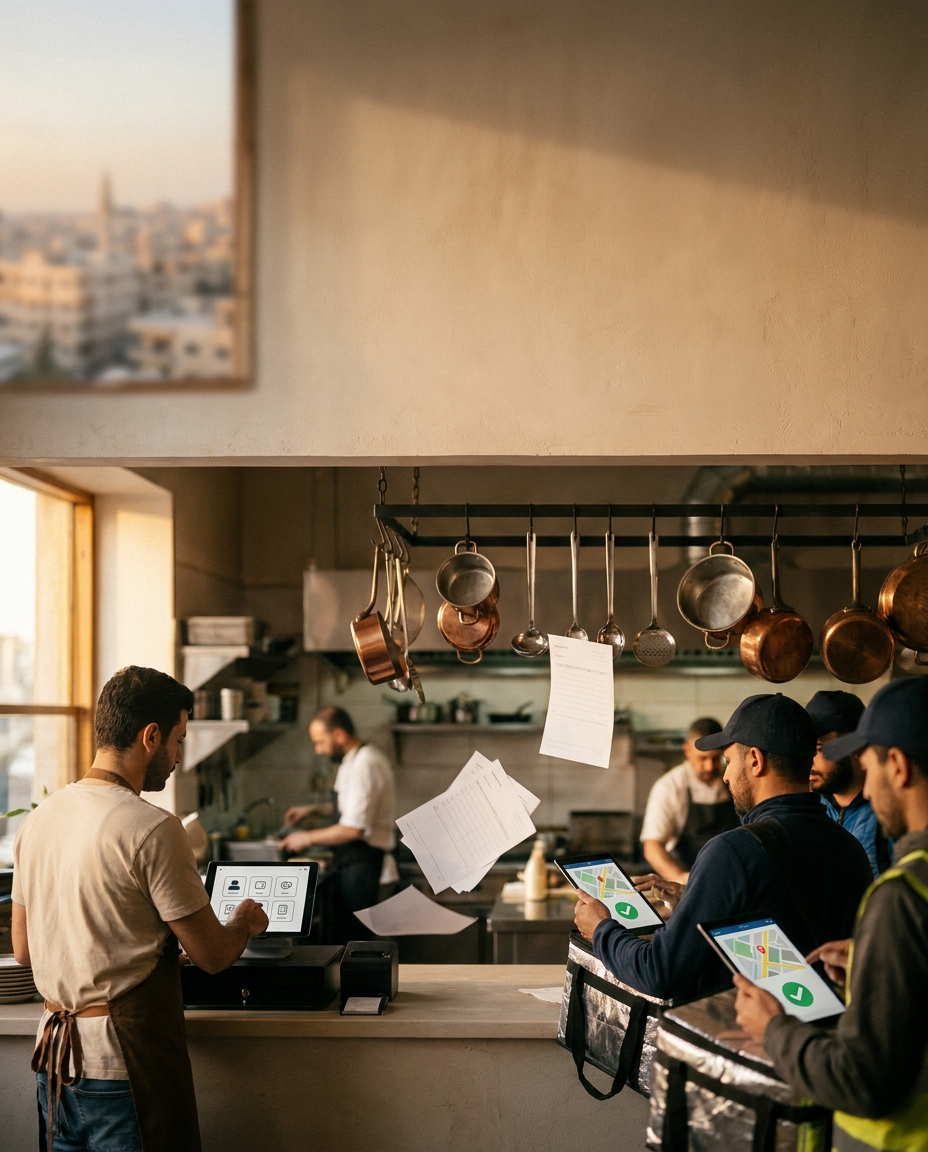
About 6 in 10 restaurants and food shops in Damascus lose at least one delivery order daily simply because the cashier's paper ticket smudged or vanished before it reached the kitchen. Sales agent order automation Syria is not a luxury here — it's the difference between an order delivered and a customer gone.
The order written on paper either goes with the wrong agent or sits forgotten at the cashier, while the kitchen waits. The customer is still on the line, and the agent is looking for a missing invoice. Imagine how many meals are lost just because the cashier’s desk has no instant logging system.
The operational problem
Lost delivery orders are not just one meal gone; they are lost trust and lost daily revenue. When the paper goes missing, the cashier must re-enter the order, the kitchen must restart, and the agent waits longer. Every extra minute in the kitchen means other orders get delayed.
We have seen restaurants manage orders through three separate sources: a notebook, messages on WhatsApp, and a paper cashier slip. None of them talk to each other. The result: an order gets recorded twice or never at all. Month-end closing in such a pattern takes days, because you sift through notebooks and messages.
This chaos drains management time. Instead of improving the menu or service quality, the owner spends hours each week tracking lost orders and verifying invoices. All this impacts customer satisfaction and reputation.
A customer who orders but doesn’t get their food is unlikely to repeat. In a crowded delivery market, losing one customer means losing a chain of future orders.
Why off-the-shelf solutions fall short
POS systems or quick kitchen apps often focus on sales logging at the cashier but don’t link agent movement to actual delivery.
- An off-the-shelf system might log the order but won’t notice if the paper disappears.
- Many don’t operate efficiently with multi-language or Arabic-first menus.
- Linking to agent movement requires custom integration not available in ready-made tools.
- No instant alerts to all parties (cashier, kitchen, agent) when a change occurs.
- Hard to modify flow to match a local restaurant’s operation.
TRBD’s fix
At TRBD, we use web platform development and mobile apps to let orders move smoothly from cashier to kitchen to agent.
Project steps:
- An exploratory session to understand current order flow and issues.
- Design a simple order entry UI for the cashier: input order, assign agent, send.
- Build an integrated system linking cashier, kitchen, and agent via mobile app.
- Integrate instant notifications for each party.
- Train staff so it becomes part of their daily routine.
Scope includes:
- Arabic-first UI.
- API integration for real-time order status updates.
- Daily report panel showing fulfilled and missing orders.
Expected outcomes:
- End paper loss by instant logging.
- Faster daily closing.
- Increased customer satisfaction by delivering on time.
How a client starts with us
Email us at info@trbd.net or via WhatsApp Turkey https://wa.me/905537323153 or WhatsApp Syria https://wa.me/963992367582. We offer a free initial evaluation session for interested restaurants.
Toward a new operating model for Damascus restaurants
Restaurants moving toward sales agent order automation Syria enter a more competitive market with higher confidence. The local market now depends on speed of response, not just food quality.
In numbers, we’ve seen restaurants after automation close their month in less than two working days, compared to a full week before. This means faster control over inventory and invoices.
Compared to Gulf markets, Damascus restaurants adopting automation excel in reducing errors, a difference that turns into a competitive edge. Recommendation: any restaurant losing orders more than once a week needs to start automation now before the same mistake hits the same customer.
One indicator from the article: every minute of kitchen delay leads to a chain of late orders. Cutting these minutes can rebuild customer trust quickly.