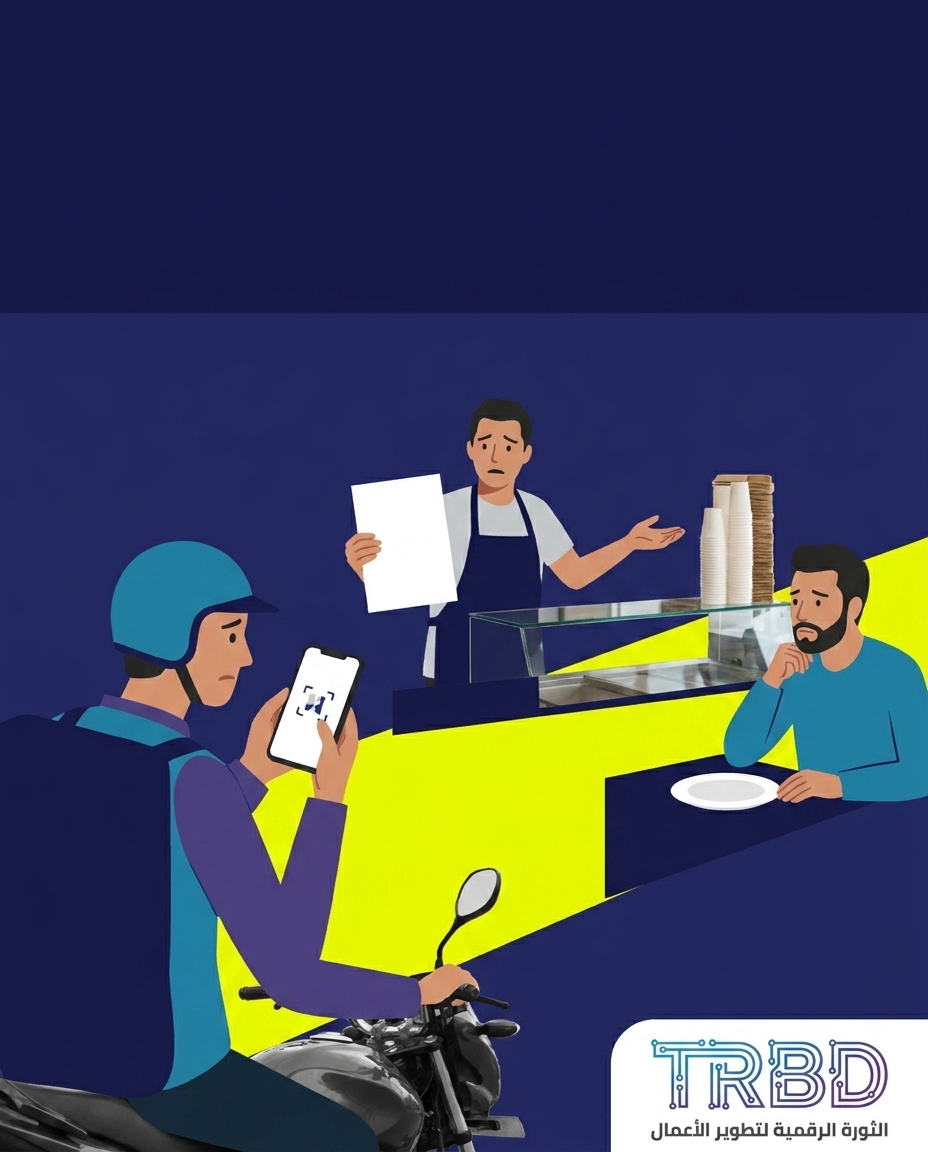
The difference between customer service and customer experience in Syria becomes clear when you see three signs repeating every week: missing items, wrong addresses, and two similar orders sent to the same customer.
These come straight from chaos: the restaurant owner logs the order on the WhatsApp app, a staff member writes it down in a paper notebook, and the kitchen works from a hastily scribbled copy. The result? A dish returns from delivery because it went to another customer.
The operational problem
This chaos is not just embarrassment — it’s wasted time, cost, and a damaged reputation. A small restaurant in Damascus can see 7–10 orders a month mixed or forgotten because all orders scatter between the WhatsApp app and the notebook.
Around 7 out of 10 business owners we know run orders and invoices the same way: a mix of Excel and WhatsApp, without a dedicated system. This makes any update or follow-up take hours, sometimes days. Closing the month in this environment can take 5–10 working days, wasting the first week entirely.
The mess appears in simple things: incomplete addresses, orders without clear payment, or the owner not knowing if the customer returned again. That’s the difference between customer service and customer experience in Syria: the first tries to calm the customer after the issue, the second prevents the issue before it happens.
The kitchen works with incomplete orders, delivery drivers reroute to another address, and customers feel the restaurant doesn’t recognize them — a negative feeling that lowers repeat order likelihood.
Why off‑the‑shelf solutions fall short
POS systems exist, but not every restaurant can use them efficiently.
- Interfaces are often English‑only, raising new staff training time.
- Many do not integrate directly with WhatsApp or Telegram apps.
- Custom steps for the kitchen can’t be added easily.
- Slow updates for data or addresses.
- No link between customer data and orders that prevents duplication.
A generic system may solve a small part but leave operations messy.
TRBD’s fix
The practical choice is a custom web platform or mobile app for the restaurant.
TRBD’s services include “Web Platform Development” and “Mobile Apps.” Here, we build one that links orders, addresses, and payments.
Project steps:
- Discovery session: Map current order flow and spot losses.
- Arabic‑first UI design: Enables any new staff to be trained in under 4 hours.
- Order‑data binding: Every order from the WhatsApp app turns into a unified digital card.
- Delivery integration: Sends live notifications to kitchen and driver.
- Improved customer experience: Sends customers order confirmation with an estimated delivery time.
The system ensures orders only leave the kitchen when data is complete. After the first quarter, many owners could close monthly invoicing in under 48 hours.
How to start with us
Email info@trbd.net or message via WhatsApp Turkey https://wa.me/905537323153 or WhatsApp Syria https://wa.me/963992367582. Request a free initial assessment to see if a custom system suits your idea.
Towards a new operational model for Damascus restaurants
The chaos we’ve seen in Damascus restaurants is tied to online sales expansion. The market is growing, and customers judge not just taste but delivery accuracy.
The difference between customer service and customer experience in Syria is deciding winners and losers: one focuses on responding after an error, the other ensures the error never happens.
With around 6 in 10 clients realizing after the first session they need a custom system, the trend is clear: restaurants investing in custom order management will see fewer operational problems and more repeat orders.
Practical tip: audit your order flow for two weeks, log each loss or delay point, and check if your current system covers them. If not, consider a custom fix.