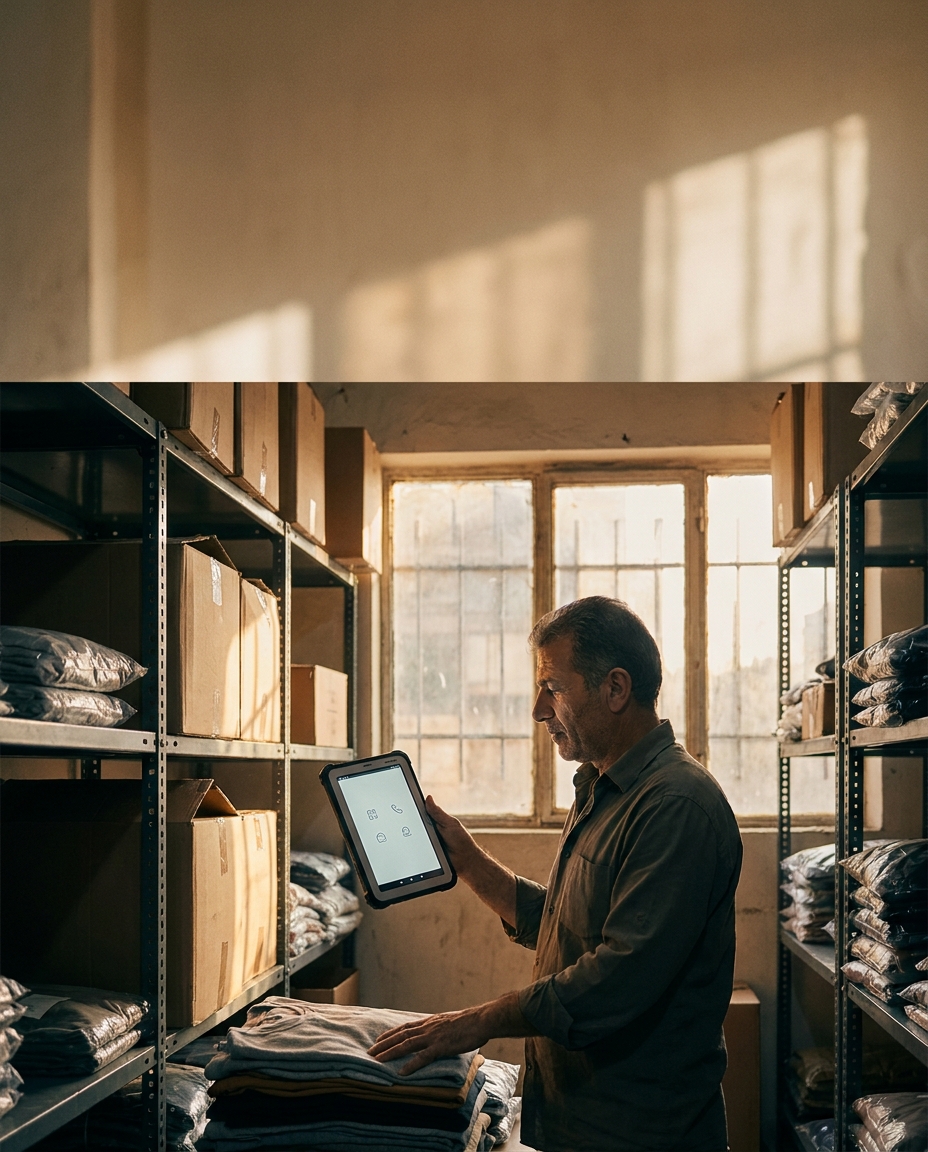
Quotation follow-up Syria is not a side note for an online clothing owner; when a restock quote slips, orders stall in the warehouse with no items ready to pick. Around 7 out of 10 owners we meet still run the flow with Excel, the WhatsApp app, and phone calls, and juggle 3 to 5 separate tools that poison the “order-ready” moment.
The outcome is obvious: the warehouse clerk only hears “it’s ready” after asking again and again, and the cashier turns into a switchboard between an impatient buyer and a confused stockroom. This is not a tiny glitch; it is a daily leak in brand trust and service quality.
The operational problem
The order lands from the website. Cash confirms payment or marks COD. Then the chase starts: the cashier sends a screenshot over the WhatsApp app, the warehouse sees it later, and asks if size M is in stock. There is no formal signal, just scattered messages and long voice notes.
This pattern burns time and creates friction. Every minute of missing info jams the rest of the queue. Staff end up chasing a “ready” word instead of preparing the order. The buyer, who already paid, feels the shop is sloppy — the real issue is a late signal.
The cost is not only staff minutes. Every delayed order raises the chance of cancellation or swap, with ripple effects: printed paper gets lost, screenshots disappear, and sizes change without an update. On top, inventory turns fictional because the final status never arrives.
We see this when tools multiply and don’t talk: the website, Excel, the WhatsApp app, an old accounting program, and a POS device at the shop. Between 3 to 5 tools fight for the truth. The handoff from “paid” to “sent to warehouse” must be a single button, not ten back-and-forth checks.
Where quotation follow-up Syria fits in
When the store does not follow up vendor quotes, inventory thins out. Here, quotation follow-up Syria becomes a domino piece. No black shirt size L? A ready order turns into a pending order.
The link is direct: if your “quote–purchase–replenish” path has no alerts and no tracking, shipping pressure becomes noise. You need two synchronized lanes: instant prep for what is in stock, and a clean restock lane that does not rely on memory or missing threads.
Tie quotation follow-up Syria to the pick-pack flow to give staff the full picture: what can ship now, what is waiting for pricing or replenishment, and when to notify the buyer early instead of leaving them in the dark.
Why off‑the‑shelf tools won’t cut it
POS software shines at the counter, but once you add an online site, a separate warehouse, and multi-channel orders, its limits surface. It was built for pay-and-hand-over, not for prepare, pick, pack, and ship-status updates.
Most generic CRMs focus on campaigns and client messaging. Your pain here is operational: when does the order move from “paid” to “sent to warehouse”? Who owns the pick task? How far is packing? How many orders point to the same shelf? You need ground-level flow, not templates.
- Most packages do not provide a plain Arabic button like: Send to warehouse with automatic state change and stock tie-in.
- It is hard to unify inputs from multiple channels into one flow without custom development.
- Interfaces are often English-first and confusing for a new floor team, while an Arabic-first UI cuts onboarding to under 4 hours for non-technical staff.
- Task logic is rigid: Pick, Confirm, Pack, Print label, and overdue nudges are not modeled well.
- Vendor quotation tracking lives in emails and Excel, far from the order path.
The TRBD approach
Two services fit this day-to-day need: Web platform development, and custom ERP/CRM systems. We build a simple but strict pipeline: a unified order state from payment to delivery, with one button that dispatches to the warehouse and auto-assigns a pick task.
What do we actually ship? An Orders screen with state filters, a Send to warehouse button, a prep message to the owner, and a plain Arabic picking list with clear tasks: Pick item, Confirm, Pack, Ready to ship. At every step, stock adjusts in reality, and a precise signal goes back to cash.
We add, if needed: shelf barcodes or a fast manual alternative, label printing via a single action, and an Overdue notice after a set time. All with an Arabic-first UI, so a new floor hire can be fully productive in under 4 hours instead of shadowing for days.
Project steps are straightforward:
A short on-site discovery. We map your current flow and define your order states.
A first production version within the typical launch window of about a month to a month and a half from the first session, depending on complexity and departments.
One live week to watch error alerts and confusion points, then tighten Arabic labels for elements: Send, Undo, Show notifications.
Connect quotation follow-up Syria to the replenish lane: New quotation, Follow-up, Convert to PO, and link pending orders when relevant.
After stabilization, we add a second module like a simple reports screen for supervisors. Adding a new module on top of a running system usually takes two to three weeks because the data model and auth are already in place.
The result: the ten repeated asks disappear. Pressure becomes a single button press, and the information rides with the order instead of living in pictures, voice notes, and shouts.
How to start with us
Email info@trbd.net or message us on WhatsApp Turkey at https://wa.me/905537323153 or WhatsApp Syria at https://wa.me/963992367582. We set up a free first assessment of your order and warehouse flow and give you a practical recommendation with a clear timeline.
Toward a stockroom that stops asking the same question
Many online shops still run on a mix of Excel, the WhatsApp app, and scattered programs. Our notes say roughly 7 out of 10 are still there. The cure is not “a new program” alone. It is one path to truth: a dispatch button, a claimed task, a timer, and a clean acknowledgment that reconciles cash with the stockroom.
Real impact shows when the UI is Arabic-first. Across our teams and clients, onboarding non-tech staff drops to under 4 hours when labels are plain: Pick instead of a code or cryptic term. That eases shifts, reduces input errors, and saves supervisors from repeating the same explanation.
Time also matters. A first production version typically lands in a month to a month and a half. That window is perfect for renaming shelves, marking locations, and preparing the warehouse crew for the new flow. After that, you can add a reports screen or deepen the link between quotation follow-up Syria and the purchase cycle.
If you see orders stalling because the team is waiting for a “ready” word over the WhatsApp app, your first square is clear: unify the signal, assign the button, and let the state update itself. Seen it at your shop? Put it on the table. What is the biggest headache from this list for you?